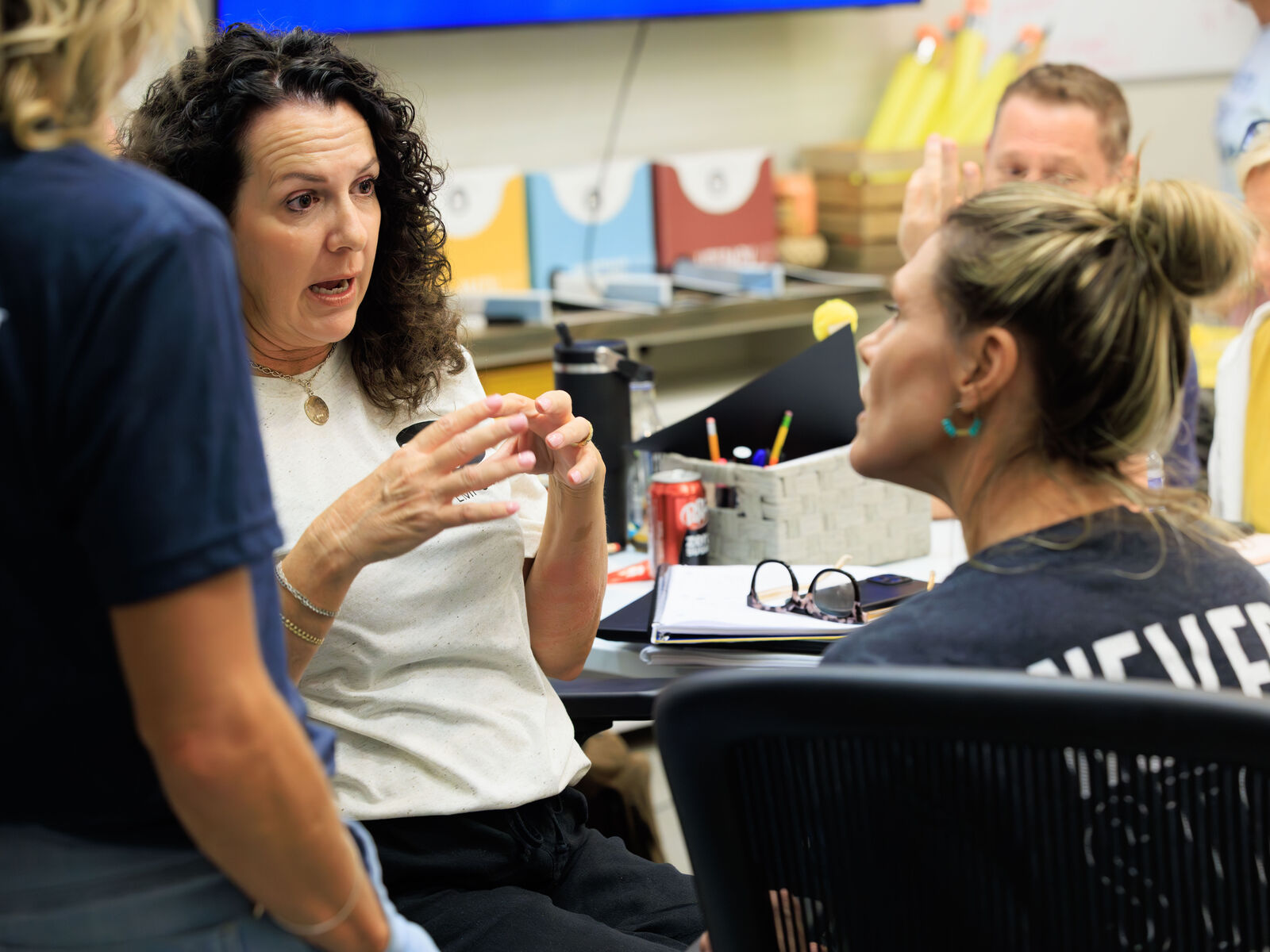
You've seen it before: A dynamic PD day leaves everyone buzzing with new ideas and sticky notes full of plans. Fast-forward six weeks, and those same strategies are quietly gathering dust.
Most professional development fails not because teachers resist change, but because they lack the time, support, and follow-through needed to implement new practices consistently in the classroom.
Teachers are navigating unfinished learning, behavior challenges, testing pressure, intervention requirements, staffing shortages, and competing initiatives. Even valuable training can quickly get pushed aside when implementation depends entirely on individual effort.
Schools that see lasting instructional improvement approach professional learning differently. Rather than treating PD as a one-day event, they build systems that help teachers apply strategies, receive feedback, collaborate with colleagues, and refine instruction over time.
The difference isn't better training. It's better implementation.
What Is Professional Development for Teachers?
Professional development is the ongoing learning teachers and school leaders engage in to improve instruction, strengthen student outcomes, and build consistency across classrooms. It can include workshops, instructional coaching, collaborative planning, conferences, classroom observations, and other forms of job-embedded support designed to strengthen teaching practice over time.
Yet many school leaders face the same challenge: despite significant investments in professional learning, classroom instruction often changes very little. The problem is not a lack of training opportunities. Districts can spend thousands of dollars on workshops, speakers, and professional learning days and still see limited impact months later.
Exposure is not implementation. Teachers need opportunities to apply new strategies, receive feedback, solve classroom challenges, and refine instruction in real classroom settings. Without those supports, even high-quality professional development often fades as the demands of the school year take over.
That's why many schools are moving beyond one-time workshops and investing in instructional coaching, collaborative planning structures, classroom-based support, and long-term implementation systems that help teachers turn learning into practice.

Why Most Professional Development Fails: The PD Implementation Failure Cycle
Many schools unintentionally assume instructional improvement happens automatically after training. In reality, most initiatives follow a predictable cycle.This cycle happens constantly in education. Schools mistake exposure for implementation. But hearing about a strategy is very different from using it effectively every day with students.
PD Implementation Failure Cycle
| Stage | What Happens |
| Excitement | Teachers leave training motivated and optimistic |
| Overload | Multiple initiatives compete for attention simultaneously |
| Survival Mode | Teachers revert to familiar instructional practices |
| Frustration | Staff perceive inconsistency and initiative fatigue |
| Abandonment | Schools move to another new initiative before implementation stabilizes |
Breaking this cycle starts with honest conversations about capacity—and realistic support systems that respect the full lives of teachers.
What Research Says About Effective Professional Development
Research on professional learning has become increasingly consistent over the past decade. The Learning Policy Institute identified several characteristics common to effective professional development:
- sustained duration
- active learning
- collaboration
- modeling
- coaching support
- content-specific focus
Research from the Institute of Education Sciences also found that professional development under 14 total hours showed little measurable impact on student achievement. Many schools still rely heavily on one-time workshop models with limited follow-up.
John Hattie’s research on collective teacher efficacy reinforces another important point: teachers improve faster when they collaborate around shared instructional goals and evidence of student learning.
The takeaway is pretty clear. Professional development works best when it improves classroom instruction, not just teacher awareness.
Key Takeaways
- Effective professional development improves classroom instruction, not just teacher awareness.
- Most PD struggles during implementation, not during planning.
- One-time workshops rarely lead to lasting instructional change.
- Teachers thrive when they have coaching, collaboration time, and realistic opportunities to practice—not just inspiration.
- Strong PD focuses on student thinking and classroom application.
- Schools improve faster when they focus on fewer instructional priorities.
- Sustainable improvement happens when PD stops feeling like an add-on and starts feeling like the supportive backbone of great teaching.
- Teachers are more engaged when PD respects classroom realities and implementation challenges.
The 4 Levels of Teacher Professional Development
Not all PD serves the same purpose. One reason schools become frustrated with professional learning is that they expect introductory sessions to create immediate, deep instructional change. Real instructional growth usually happens in stages.
Stages of Professional Learning
| Level | Description | Typical Outcome |
| Level 1: Awareness PD | Teachers are introduced to new ideas and frameworks | Awareness increases |
| Level 2: Strategy PD | Teachers learn practical classroom strategies | Initial implementation begins |
| Level 3: Implementation PD | Teachers receive coaching, feedback, and reflection opportunities | Instruction improves more consistently |
| Level 4: Instructional Culture PD | Professional learning becomes embedded in daily school practice | Sustainable instructional improvement develops |
Many schools remain stuck between Levels 1 and 2. Teachers attend presentations and collect resources, but implementation fades because systems for sustained support never fully develop. Schools that improve instruction long term intentionally build structures that help teachers reach Levels 3 and 4.
What Effective Teacher Professional Development Looks Like in Practice
Remember those strategies that usually fade? In schools that get implementation right, they actually show up in the daily rhythm of classrooms.
In these classrooms, students spend more time:
- discussing ideas
- explaining reasoning
- solving problems collaboratively
- analyzing misconceptions
- defending strategies
For example, in mathematics classrooms, students might debate whether ⅝ > ¾ is true by using visual models, benchmark reasoning, or fraction comparisons instead of memorized procedures alone.
That kind of student-centered discussion usually develops when teachers receive sustained support around questioning strategies, conceptual understanding, and academic discourse. Meaningful PD changes what learning actually looks like for students.
What Strong PD Looks Like Across Grade Levels
Strong professional development should match the needs of both students and teachers at different grade levels. In K–2 classrooms, PD often focuses on foundational number sense, phonemic awareness, classroom routines, and hands-on learning.
In grades 3–5, the focus usually shifts toward problem solving, conceptual understanding, and helping students explain their thinking.
In middle school, teachers often need support with mathematical reasoning, academic discussion, and intervention systems as content becomes more complex. At the high school level, professional learning tends to focus more on deeper content knowledge, critical thinking, and student independence.
The best professional development is not one-size-fits-all. What works in a kindergarten classroom will not necessarily work in Algebra II.
How Schools Successfully Implement Professional Development
This is where implementation science really starts to matter. A district might roll out a new math curriculum, MTSS intervention blocks, walkthrough tools, and restorative practices all at the same time. None of those initiatives are necessarily bad on their own. The problem is usually sequencing and capacity.
Teachers cannot deeply implement four major systems simultaneously while still maintaining strong day-to-day instruction. Schools that sustain improvement tend to narrow their instructional priorities, phase implementation more intentionally, provide coaching support, protect collaboration time, and reduce competing demands during rollout periods. Depth usually produces stronger long-term results than speed.
Warning Signs Your Professional Development Model Is Failing
Schools often recognize PD problems only after teacher frustration becomes widespread. Several warning signs tend to appear earlier. These problems are often systems issues, not teacher issues.
PD Model Failing Signs
| Warning Sign | What It Often Indicates |
| Teachers describe initiatives as “another thing” | Initiative overload |
| Classroom practices vary dramatically | Lack of instructional coherence |
| Coaching conversations focus mostly on compliance | Weak instructional support systems |
| Staff turnover repeatedly resets implementation | Poor onboarding and sustainability |
| Teachers cannot explain the instructional purpose behind initiatives | Weak communication and clarity |
Why Teachers Often Distrust Professional Development
Many teachers have experienced PD that felt disconnected from the realities of classroom instruction. Some initiatives contradict previous training. Others introduce major changes without meaningful support afterward.
In many cases, teachers are expected to implement new strategies immediately while still managing pacing demands, intervention groups, behavior concerns, and testing pressures. When PD feels compliance-driven instead of student-centered, skepticism naturally grows.
Teachers are far more likely to engage in professional learning when it acknowledges implementation challenges and respects teacher expertise. Strong professional development provides practical classroom support and focuses on student thinking.
How to Choose a Professional Development Provider for Schools
Many schools already know what effective PD should look like. The challenge is building systems that teachers can realistically sustain. That is why many districts partner with educational consulting organizations that specialize in instructional improvement, coaching, intervention support, and implementation systems.
Organizations like Empower Education Connections partner with schools to provide practical support in areas such as:
- mathematics instruction
- student-centered problem solving
- hands-on learning
- classroom-centered implementation support
Strong consulting partnerships help schools build instructional systems that improve what students experience every day while supporting teachers with practical, research-informed strategies. The goal isn’t just more training—it’s real change in what students experience every day.
When evaluating PD providers, schools should look beyond polished presentations and ask:
- Is the support realistic?
- Is implementation sustainable?
- Does it connect directly to classroom instruction?
- Is coaching included?
- Does the work respect teacher expertise?
- Is the approach adaptable to different school contexts?
Final Thoughts
Professional development should never feel like one more item on an already overflowing plate. When done right, it becomes the supportive backbone that makes everything else in teaching easier, clearer, and more effective.
Coaching, real collaboration, focused priorities, and classroom-based support are what turn good ideas into lasting instructional change. The result? Teachers who feel capable instead of overwhelmed, and students who experience richer discussions, stronger reasoning, and meaningful learning every single day. That’s the kind of investment that truly transforms schools.
Frequently Asked Questions
Research shows that effective professional development is sustained, collaborative, and focused on classroom application. Teachers benefit from active learning experiences, coaching support, and opportunities to practice new strategies. Strong PD is also content-specific and directly connected to student learning goals. The most successful programs focus on improving instruction rather than simply increasing awareness.
Many professional development initiatives fail because schools focus on training rather than implementation. Teachers may leave a workshop motivated, but without ongoing support, competing priorities often push new strategies aside. Initiative overload, limited time, and lack of coaching make sustained change difficult. Successful professional development includes structures that help teachers apply and refine new practices over time.
Common warning signs include teachers describing initiatives as "just another thing," inconsistent classroom practices, and coaching conversations focused primarily on compliance. Schools may also experience implementation setbacks due to staff turnover or unclear communication about instructional goals. When teachers cannot explain the purpose behind initiatives, it often indicates deeper system-level issues. Recognizing these signs early allows schools to adjust before frustration grows.
Effective professional development should reflect the instructional needs of different age groups. Early elementary teachers may focus on foundational literacy, number sense, and classroom routines, while upper elementary teachers often emphasize problem solving and conceptual understanding. Middle and high school educators typically need support with deeper content knowledge, reasoning, and student independence. Tailoring PD to grade-level needs makes it more relevant and impactful.
Schools should look for providers that offer practical, classroom-focused support rather than just presentations. Strong providers include coaching, implementation guidance, and strategies that teachers can realistically sustain. It is also important to evaluate whether the approach respects teacher expertise and can be adapted to different school contexts. The best partnerships focus on improving student learning while supporting teachers throughout the implementation process.