
In September, you roll out a clear plan for math professional development. Teachers spend a day learning new strategies, working through examples, and discussing ways to improve math instruction. They leave with resources and ideas to use in their classrooms.
Then things get busy and the pace increases. Students react in surprising ways. A strategy that seemed easy during training becomes more challenging with a full class. By October, some teachers have adopted the new practices, while others have gone back to their old routines.
This leads to an important question: What needs to happen after math professional development so that teacher learning effectively benefits students?
More training does not always lead to better student results. What matters is how much of that learning actually reaches students.
What Makes Math Professional Development Effective?
- Math PD works when it focuses on specific mathematics and how students understand it.
- Practicing a strategy in training is not the same as using it with students.
- Teacher learning is only the first step. Implementation is the missing middle.
- Coaching, collaboration, and follow-up decide whether PD sticks.
- Leaders need enough math-instruction knowledge to support what they expect to see.
- Measure classroom practice and student work, not PD hours alone.
What Does Research Say About Professional Development for Math Teachers?
Research keeps pointing to the same pattern: math PD is more likely to change classroom practice when teachers study specific mathematics, actively practice instruction, and connect that learning to their curriculum and students.
A study of more than 1,000 math and science teachers found three features linked to stronger teacher learning and changes in practice: content focus, active learning, and coherence. For math teachers, that means PD should focus on specific concepts, give teachers time to practice, examine student thinking and misconceptions, and connect the work to curriculum and classroom goals. (journals.sagepub.com)
| Research-Supported Feature | What It Looks Like in Math PD |
| Content focus | Studying specific mathematics such as fractions, number sense, or proportional reasoning |
| Active learning | Solving tasks, comparing strategies, and practicing instruction |
| Student thinking | Examining misconceptions, student work, and representations |
| Coherence | Connecting learning to curriculum, standards, assessment, and district goals |
| Collective learning | Teams working on shared instructional challenges |
| Classroom application | Trying practices with students and examining what happens |
The research also makes an important distinction for leaders: teacher learning does not automatically lead to higher student achievement. Teachers can know more and even improve parts of their instruction without students showing the same gains.
That is why strong math PD cannot stop at new knowledge. It also needs a plan for putting that learning into practice and checking how it changes what students do and understand.
Examples of Effective Math Professional Development
Examples of Effective Math Professional Development
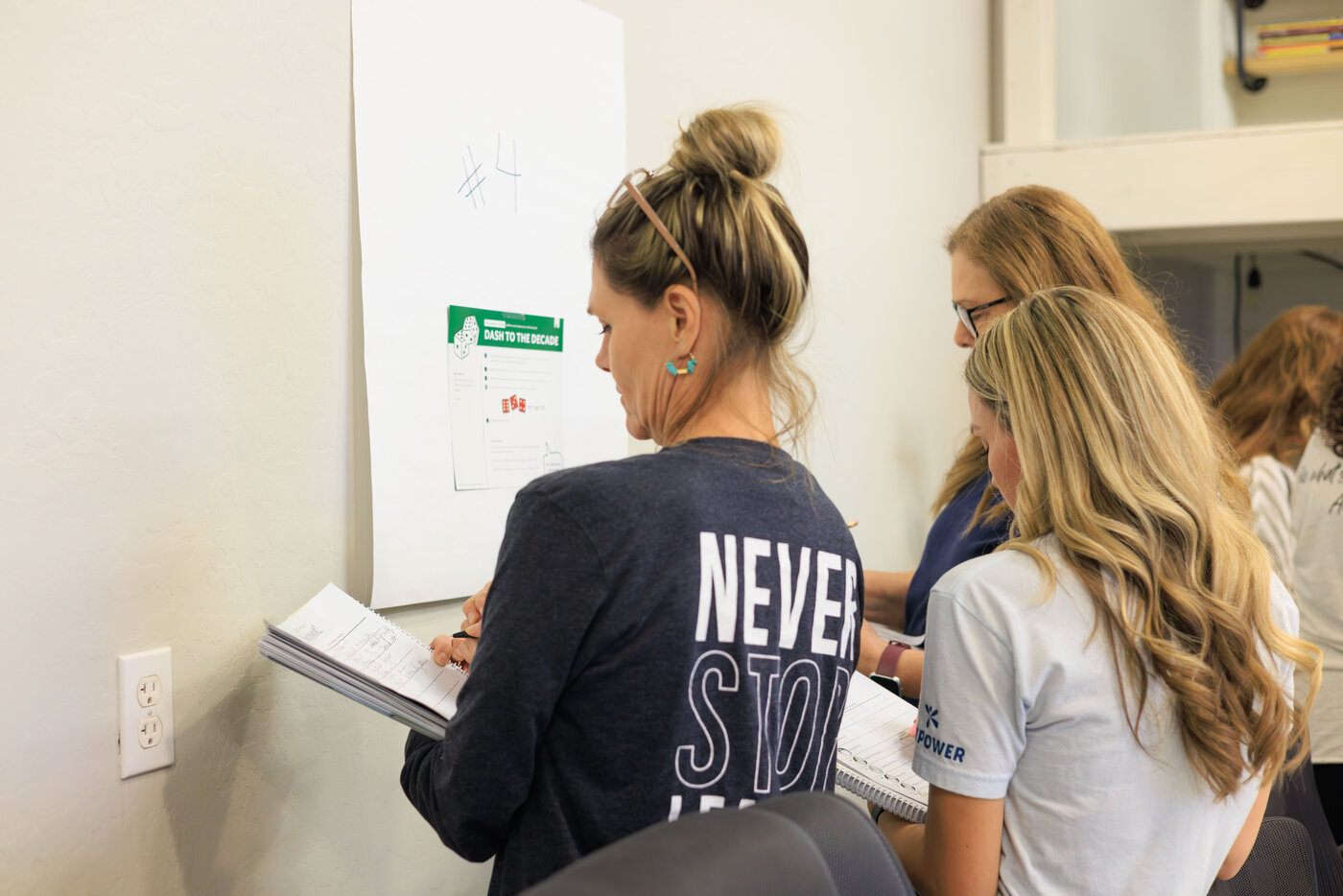
Research tells us what effective math PD should include. These examples from Empower Education Connections show what that looks like when teachers and leaders work with actual mathematics, look closely at instruction, and leave with something they can use the next day.
Building Greater Understanding of Fractions, Decimals, and Percentages
The goal was not to add another fraction activity. It was to help teachers strengthen conceptual understanding and move more flexibly among concrete, pictorial, and abstract representations.
Teachers used manipulatives, number lines, and grid models to make sense of the mathematics themselves first. Then they explored how to shift among those representations based on what students needed, instead of treating concrete-pictorial-abstract as a rigid sequence.
What leaders should see afterward: Students using models to explain equivalence and relationships, not jumping straight to a procedure when they get stuck.
Taking a Closer Look at the Math Block
This session helped teachers look at their own math block with more intention. They examined how they teach fluency, use anchor charts, include problem solving, and organize the rest of the lesson: daily numeracy, math talk, guided and independent practice, small groups, intervention, workstations, and closure.
Instead of leaving with a stack of disconnected activities, teachers compared the training to their current practice and identified one or two parts of the block worth strengthening.
What leaders should see afterward: A more coherent math block, with clearer purpose for each part of the lesson and fewer isolated activities.
Helping Administrators Lead Math Instruction
Teachers cannot carry implementation alone. This session helped leaders understand the instructional work they are responsible for supporting.
Administrators examined grade-level standards, pacing, lesson planning, and instructional expectations. They worked with year-at-a-glance documents, deconstructed standards, and talked through how those tools could create more consistency across classrooms.
When leaders know what good math teaching looks like, they ask better questions in walkthroughs, make stronger resource decisions, and support implementation with more clarity.
What leaders should see afterward: Shared language about math instruction, more focused walkthroughs, and support that matches what teachers were asked to try.
What These Examples Have in Common
The audience and format may change, but the work is the same. Teachers and leaders do more than listen. They work with math, look closely at instruction, reflect on current practice, and plan how the learning will show up with students.

Does More Math PD Improve Student Achievement?
One of the most useful studies for administrators is also one of the most surprising. An Institute of Education Sciences randomized study examined an intensive program for fourth-grade teachers. Teachers received an 80-hour mathematics course, 13 hours of collaborative learning focused on student work, and individual coaching.
Teachers' mathematical knowledge increased substantially, and the quality of their math explanations improved. But student mathematics achievement did not significantly increase. (ies.ed.gov)
The takeaway isn’t that intensive PD is ineffective. Teacher learning matters, but it is not the end goal. Teachers need to turn new knowledge into teaching that changes what students do and understand.
How Do You Measure the Impact of Math PD?
Schools often evaluate professional development at the beginning of the process. Did teachers attend? Did they find the training useful? Did they learn something?
Those questions are helpful, but they do not show whether the learning reached students. A better approach is to follow professional learning from the training room into the classroom.
The PD-to-Student Pathway:
Professional Learning → Teacher Understanding → Classroom Implementation → Quality of Implementation → Student Experience → Student Learning
| Stage | What School Leaders Should Look For |
| Teacher Understanding | Do teachers understand what they learned? |
| Classroom Implementation | Is the new practice showing up in classrooms? |
| Quality of Implementation | Are teachers using it effectively? |
| Student Experience | Are students thinking, talking, or working differently in math? |
| Student Learning | What does student work or assessment data show? |
Attendance and positive surveys only tell leaders what happened during PD. Walkthroughs, coaching conversations, student work, classroom discussions, and assessment data help show what happened afterward.
A PD program can increase teacher knowledge but still fall short before that learning reaches students. This is the missing middle of professional development. When results are not improving, the pathway helps you identify where support is needed instead of assuming the entire initiative failed.
Why Administrators Need Math Professional Development, Too
Math PD usually targets teachers, but you play a key role in making sure that learning is used. You do not need to be a math expert, but it helps if you understand the teaching practices they expect from teachers.
When you understand good math instruction, you can ask better questions during walkthroughs, notice when students are productively struggling, see why teachers use different strategies or representations, and have more meaningful talks about student work. You can also tell the difference between a hectic classroom and one where students are truly thinking about math.
When you join in on the math PD, it helps create a shared language for teaching across the school or district. When teachers and leaders know the goals, you can support implementation more clearly and consistently.
How Job-Embedded Coaching Helps Close the Implementation Gap
When a teacher tries a new instructional practice for the first time, it usually is not perfect. A number talk might take longer than planned. Students might see a visual model differently than expected. A new questioning strategy might not spark the discussion the teacher wanted. These moments show what needs to be adjusted.
Job-embedded coaching gives teachers an opportunity to work through those adjustments alongside someone else. Research on teacher coaching has found positive effects on instructional practice and smaller positive effects on student achievement, although much of that research is not specific to mathematics. Math-specific studies also suggest that purposeful engagement with coaching can contribute to changes in instructional practice and, in some settings, student achievement.
In mathematics, a coaching cycle might look like:
Learn → Plan → Teach → Observe → Examine Student Thinking → Adjust → Teach Again
A coach can help a teacher notice things that are difficult to see while teaching. Are students doing the mathematical thinking? Which representation helped? What misconception keeps appearing? Did the teacher's questions uncover reasoning or lead students toward an answer?
This helps professional learning continue rather than stopping when the training ends.
Questions to Ask Before Choosing Math Professional Development
You do not have to be PD experts, but you should know what you want to achieve. Asking these questions will help.
1. What specific problem are we trying to solve?
"Improve math instruction" is too general. Begin with a specific student learning need or teaching challenge.
2. What mathematics will teachers understand more deeply?
Strong math PD should go beyond generic instructional strategies.
3. How will teachers study student thinking?
Look for opportunities to examine misconceptions, strategies, representations, or student work.
4. What will teachers actually practice?
Learning about a strategy and using it well are not the same thing.
5. What should look different in classrooms afterward?
Decide what visible changes you want to see before starting professional learning.
6. What happens after the training?
Plan for coaching, collaborative planning, classroom practice, feedback, or organized follow-up.
7. How will we know whether it worked?
Decide what evidence you will look for at the teacher, classroom, and student levels before starting the initiative.
These questions help move the conversation from "What PD should we offer?" to "What change do we want to make?"
Final Thoughts
A great math PD day can energize a staff. What happens next decides how much of that energy reaches students.
Keep the focus specific. Give teachers time to practice. Stay with them as the work moves from the training room into real classrooms. Students will surprise teachers, and plans will need to change. That is not a sign the PD failed. That is the work of implementation.
When professional learning moves from training to practice to students, those PD hours become better math experiences.
Frequently Asked Questions
Effective math PD links math content with teaching techniques and student thinking. Teachers should work with math, analyze how students respond, practice teaching strategies, and use what they learn in their classrooms.
Research does not give a set number of hours that will guarantee better student achievement. Ongoing learning gives teachers more chances to practice and improve, but the quality and use of PD in the classroom matter more than the total hours.
Research shows that well-designed math PD can help student achievement, but results are mixed. Teachers may learn more without students showing the same gains, so classroom implementation is key when evaluating PD.
Job-embedded coaching links professional learning to real classroom teaching. Coaches help teachers plan, watch how students respond, give feedback, and improve their teaching based on what happens in class.
Track learning from the PD session all the way to the classroom. Focus on teacher understanding, how new practices are used, changes in student experience, and proof of student learning, instead of just looking at attendance or survey results.