
“Check your writing.”
It sounds like a simple direction. But what, exactly, should a student check?
For a first grader, “check your writing” might mean looking for a missing capital letter or period. A seventh grader may need to check punctuation around a quotation. By eleventh grade, a student may already know, “Commas are where I get myself into trouble.” They are all editing, but they should not be looking for the same things.
As students become more experienced writers, the mistakes they need to catch change too. The conventions get more complex, and little by little, you can hand more of the checking over to the writer. That shift starts with what you ask them to notice.
So instead of handing every student the same editing checklist, ask a better question: What should this writer be ready to notice and fix for themselves?
- Revision, editing, and proofreading have different purposes.
- Common writing mistakes change across grade levels.
- Younger writers benefit from a few specific editing targets.
- Older students should learn to identify their own recurring patterns of error.
- ARMS and CUPS give students a practical structure for revising and editing.
- Strong writing instruction gives students models, exemplars, useful tools, and plenty of low-stakes chances to practice.
What Are the Most Common Writing Mistakes?
Across K–12, common writing mistakes include errors in capitalization, spelling, grammar and usage, punctuation, verb usage, quotations, and citations.
But a universal list only gets us so far.
A missing period is a perfectly reasonable editing target for a beginning writer. For an eleventh grader, probably not so much. And your second graders definitely do not need a checklist packed with citation rules.
Good editing instruction helps students focus on the mistakes they are actually ready to notice and fix.
Common Writing Mistakes by Grade Level
A useful way to think about editing across K–12 is this: students move from noticing obvious errors, to managing more complex conventions, to recognizing the mistakes they personally tend to make.
| Grade | Common Convention-Level Errors | What You Can Focus On |
| K–2 | Capitalization, ending punctuation, spelling | Teach students to look for missing capitals and punctuation, then proofread a sentence or short paragraph. |
| 3–5 | Spelling, grammar, punctuation, capitalization, style, verb usage | Keep revision separate from editing so students understand the purpose of each. |
| 6–8 | Spelling, punctuation, capitalization, grammar, quotation punctuation | Teach targeted sentence-level editing followed by proofreading. |
| 9–10 | Spelling, grammar, punctuation, quotation and citation-related errors | Establish a consistent revise-edit-proofread routine. |
| 11–12 | Individual patterns of spelling, grammar, and punctuation errors | Help students identify recurring errors and create a personalized proofreading routine. |
The shift goes from teacher-directed checking to writer-directed editing.
In K–2, you might say, “Check the beginning and end of every sentence.” By grades 3–5, students can start separating “make the writing better” from “fix the errors.” Middle school writers are ready for more complex grammar, punctuation, and quotation rules.
By high school, students should have a reliable process and start recognizing their own patterns. One student knows commas are their nemesis. Another shifts verb tense halfway through a paragraph. Someone else can find a great quotation but never remembers where the punctuation goes.
As writers become more experienced, their editing checklists may need to get shorter, not longer. Instead of checking everything, students learn what they need to check.
What's the Difference Between Revising, Editing, and Proofreading?
These terms are often grouped together, but each has a different job.
| Process | Purpose | Student Thinking |
| Revision | Improve meaning, organization, clarity, and word choice | How can I make this more effective? |
| Editing | Correct conventions and sentence-level errors | What needs to be corrected? |
| Proofreading | Catch anything missed before finishing | Did I miss anything? |
A simple sequence is: Revise → Edit → Proofread
When you separate those jobs, you help students know what they are looking for each time they reread.Otherwise, “check your writing” can turn into “please notice absolutely everything at once,” which is a pretty tall order.
Use ARMS for Revision and CUPS for Editing
ARMS and CUPS give students a simple way to separate revision from editing.
ARMS: Revise the Writing
A: Add sentences or words
R: Remove unnecessary words or sentences
M: Move sentences or words
S: Substitute stronger words or sentences
ARMS gets students thinking beyond “Is this correct?” and toward “Is this actually working?” Did I repeat myself? Would moving a sentence improve the flow? Is there a clearer way to say this?
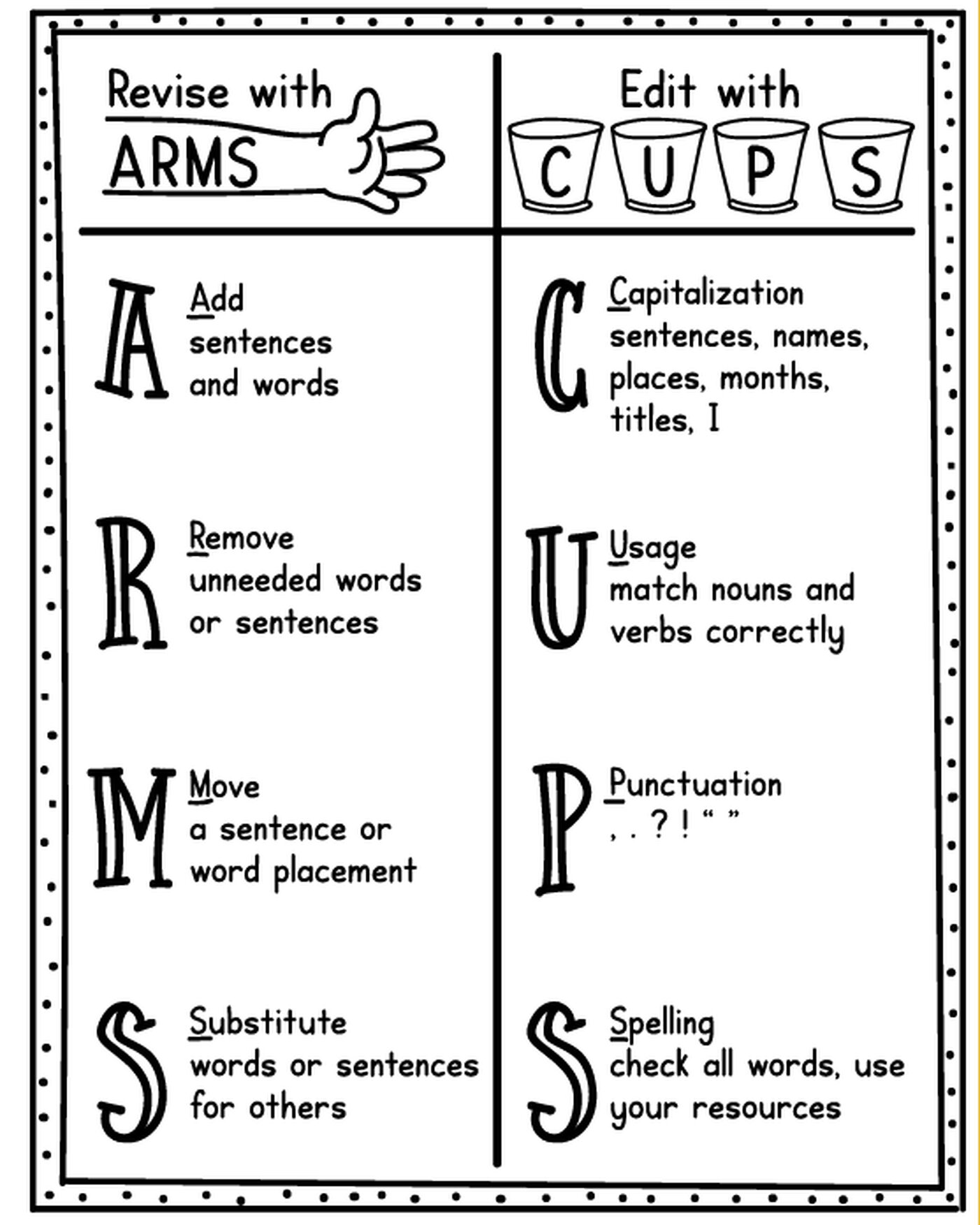
CUPS: Edit the Writing
C: Capitalization
U: Usage
P: Punctuation
S: Spelling
CUPS shifts the focus to correctness.
ARMS asks, “How can I improve this?”
CUPS asks, “What do I need to correct?”
These are useful scaffolds, but you do not want students waiting for ARMS, CUPS, or you forever. Over time, you can help them recognize what their own writing needs.
Ask a Coach: What Are We Missing in Writing Instruction?
When we asked Empower literacy coaches about common writing mistakes, they did not start with commas, spelling, or capitalization. They went straight to the instruction.
As one coach put it: “Putting up a prompt is NOT writing instruction.”
A prompt gives students something to write about. Instruction shows them how to do it. Students need to see you generate an idea, organize it, change your mind, draft, revise, and edit. That modeling is what turns an assignment into writing instruction.
Coaches also see two other gaps again and again:
- Expectations show up too late. Share rubrics and exemplars early, then return to them while students are writing—not just when the piece is almost finished.
- Too little low-stakes practice. “A big one is not including low-stakes, fluency-building practice daily.” A quick response, a short reflection, or a few sentences explaining an idea gives students a chance to write when every sentence is not headed for the gradebook.
When you make the process visible and give students regular chances to practice it, they can start using that process without you walking them through every step.

Try It in the Classroom
Convention-level errors change as students grow, but the basic routine often stays the same: slow down, notice what looks off, and make a targeted edit. These three Empower Education Connections activities work across grade bands with a few simple adjustments.
1. Color, circle, and correct
Start with a short model paragraph that includes obvious convention errors. For younger students, use one focus at a time, like capitalization or ending punctuation. For older students, layer in grammar, spelling, or even quote punctuation. Read it aloud, circle one or two spots that need attention, and think through the correction out loud before handing the rest over to students or partners.
In K–2, simple visual maps can make the routine more concrete; in 3–12, the same routine can become a quick warm-up before independent editing.
2. Revise first, edit second
Use this when students are ready to see the difference between improving ideas and fixing conventions.
Give small groups a paragraph to revise for clarity, word choice, or organization first, then ask them to do a second pass for convention errors.
In 3–5, this works well with the CUPS vs. ARMS anchor chart; in 6–8 and beyond, it connects naturally to the lesson emphasis on separating revision from editing. You can keep the task simple for elementary students and more demanding for secondary writers by adding sentence variety, grammar, or punctuation checks. The point is to help students understand that “better writing” and “correct writing” are related, but not the same thing.

3. Build a final proofreading routine
End with a fast, repeatable proofreading routine that students can use on any piece.
In K–2, students can hunt for capitals and periods with sticky notes or act as “Big-letter detectives.” In 6–8, they can use a checklist and proofread for surface errors after editing. In 9–12, the same idea becomes a personal error checklist: students name the mistakes they make most often, then use that list to do a final focused check with a partner.
The routine can stay familiar even as the expectations change. Younger students may look for one or two conventions, while older students learn to focus on their own patterns.
If you want a simple rule of thumb, keep the routine familiar and change the challenge: younger students can hunt for one or two conventions, middle-grade students can sort revision from editing, and older students can build a personal proofreading checklist they return to every time they write.
From Correcting Errors to Independent Writers
Over time, you want students to take responsibility for three things:
Know what to look for. What conventions should I check?
Know how to correct it. What rule, strategy, or resource can help me?
Know yourself as a writer. What errors do I tend to make?
That last question becomes increasingly important as students get older. A high school student who knows, “I need to check every quotation because I tend to misplace punctuation,” is learning to monitor their own writing rather than waiting for someone else to find the errors.
Final Thoughts
Strong writing instruction grows right alongside students. At first, you may be the one saying, “Check your capital letter,” or “Go back and look at that sentence.”
The next time you say “check your writing,” name one thing this writer is ready to catch. Give them a clear target, a chance to practice it, and then another chance to notice it on their own. Little by little, you can hand more of that checking over. That is how students start hearing the editing voice in their own heads—and knowing what to do next.
Frequently Asked Questions
Common writing mistakes include capitalization, spelling, grammar and usage, punctuation, verb errors, and sentence-level convention errors. Older students also encounter more complex issues involving quotations and citations.
ARMS stands for Add, Remove, Move, and Substitute. It is a revision strategy that helps students improve ideas, organization, clarity, and word choice.
CUPS stands for Capitalization, Usage, Punctuation, and Spelling. It gives students a framework for checking convention-level errors during editing.
Revision improves the meaning and effectiveness of writing. Editing corrects conventions and sentence-level errors. Students should generally revise before they edit.
Younger students need explicit instruction in what to notice, such as capitals and ending punctuation. As students grow, they should manage increasingly complex conventions and eventually identify their own recurring error patterns.
Start by modeling a few specific things to check. As students become more confident, give them more responsibility for finding, correcting, and tracking their own mistakes. By secondary school, students can use previous feedback to create personalized proofreading routines.